How Palm Reading Actually Works
How Palm Reading Actually Works
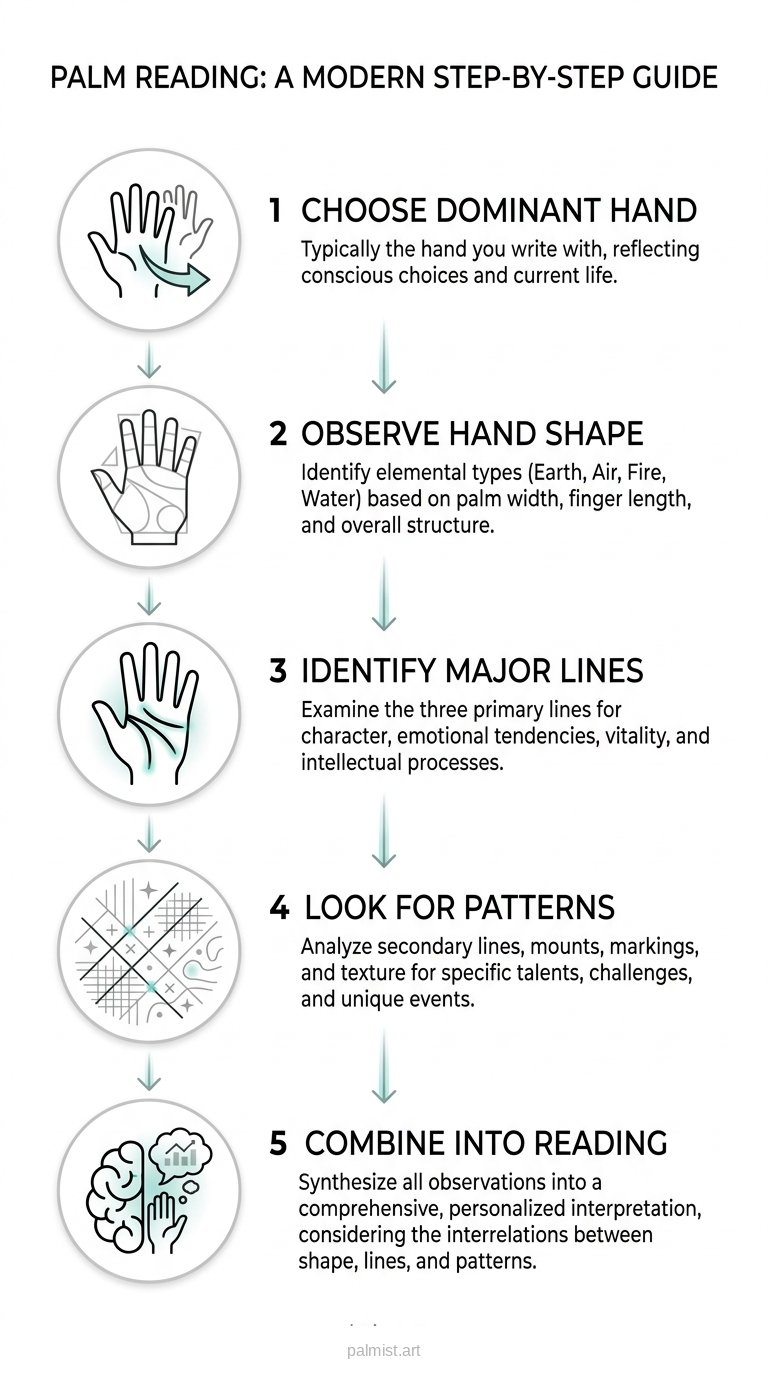
Palm reading is not about guessing. It follows a simple process.
You observe the hand in layers — starting broad, then moving into detail. Instead of jumping straight to meanings, you begin with structure.
Step 1 — Which Hand Do You Read?
The first question is always: which hand matters more?
In most modern palmistry, the dominant hand (the one you use most) shows current patterns, choices, and direction. The non-dominant hand shows baseline tendencies and natural inclinations.
Think of it like this: non-dominant hand = potential, dominant hand = how that potential is being used.
Step 2 — Start With the Overall Shape
Before looking at lines, look at the hand as a whole. Is the palm wide or narrow? Are the fingers long or short? Does the hand look firm or soft?
These clues give you a general personality baseline. Details come later. Shape sets the context.
Step 3 — Identify the Major Lines
Now move to the main lines: life line (vitality), head line (thinking style), heart line (emotional tendencies), and fate line (direction).
You are not "reading meanings" yet. You are observing length, depth, clarity, breaks or changes.
Step 4 — Look for Patterns, Not Isolated Signs
This is where most beginners go wrong. They see one feature and jump to a conclusion.
Palm reading works by combining signals. A strong head line combined with a curved heart line means something different than either alone. No single feature tells the full story.
Step 5 — Add Secondary Details
After the major lines, consider minor lines, mounts, and markings. These add nuance — think of them as modifiers, not main signals.
Step 6 — Build a Coherent Reading
Now you combine everything: overall shape, major lines, supporting details.
A good reading is not a list. It is a coherent explanation. Instead of "this line means X," you arrive at: "This suggests a person who tends to think this way, respond this way, and approach life this way."
What Beginners Often Miss
They focus too much on one line, ignore overall shape, assume every marking is important, and expect exact answers. Palmistry doesn't work like that. It works through consistency across features.
Curious how this shows up on your own hand?
Try a personal reading →