How to Read Palm Lines: A Beginner's Guide to Palmistry
Learning how to read palms is simpler than most people think. You do not need years of study, special knowledge, or psychic ability. What you need is a basic understanding of what to look for, the patience to examine the hand carefully, and the wisdom to interpret what you see with both curiosity and humility.
Palmistry — also called chiromancy — is an ancient art of reading the lines, shapes, and features of the hand to gain insight into personality, emotional patterns, relationships, and life path. It has been practiced for over three thousand years across India, China, Greece, and Europe. It is not fortune-telling, divination, tarot, or Chinese fortune telling in the predictive sense. It is a philosophy of self-reflection rooted in centuries of observation about the connection between the hand and human character — a system for understanding well-being, personality, and potential.
This guide walks you through how to read palm lines step by step, from choosing which hand to examine to interpreting each major line and combining them into a complete reading.
Step 1: Choose Which Hand to Read
The first question every beginner asks: which hand do I read?
Your dominant hand (usually the right) reflects your current personality, conscious choices, and the life you are actively creating. This is your "made" hand — it shows who you are becoming.
Your non-dominant hand (usually the left) reflects your inherited traits, natural temperament, and the personality you were born with. This is your "given" hand — it shows your starting point.
Read both. The most interesting information often comes from comparing them. If your dominant hand shows a stronger fate line than your non-dominant hand, it means you built your sense of purpose through effort rather than having it handed to you.
In traditional Indian and Chinese palmistry, there is a gender convention — left hand for females, right for males — but most modern palmists read the dominant hand as primary regardless of gender. For more on this topic, see our guides on which hand to read and palm reading for female hands.
Step 2: Examine Your Hand Shape
Before you look at any lines, look at the hand itself. The shape of your palm and the length of your fingers reveal your fundamental temperament.
Earth hands have square palms and short fingers. They suggest a practical, grounded personality — someone who values stability, works with their hands, and prefers concrete results over abstract thought. Earth energy is reliable and steady.
Air hands have square or rectangular palms with long fingers. They suggest an intellectual, communicative nature — someone driven by ideas, learning, and social connection. Air types are curious, articulate, and sometimes restless.
Fire hands have long palms and short fingers. They suggest energy, courage, and creative drive — someone who acts on instinct, leads with enthusiasm, and craves excitement. Fire types are bold and sometimes impulsive.
Water hands have long palms and long fingers. They suggest sensitivity, intuition, and emotional depth — someone who feels deeply, processes the world through emotion, and often has artistic or creative talents. Water types are perceptive and sometimes introverted.
Most hands are a blend. Identify the dominant shape, then notice which element's qualities resonate most with your behavior and thought patterns.
Step 3: Identify the Four Major Lines
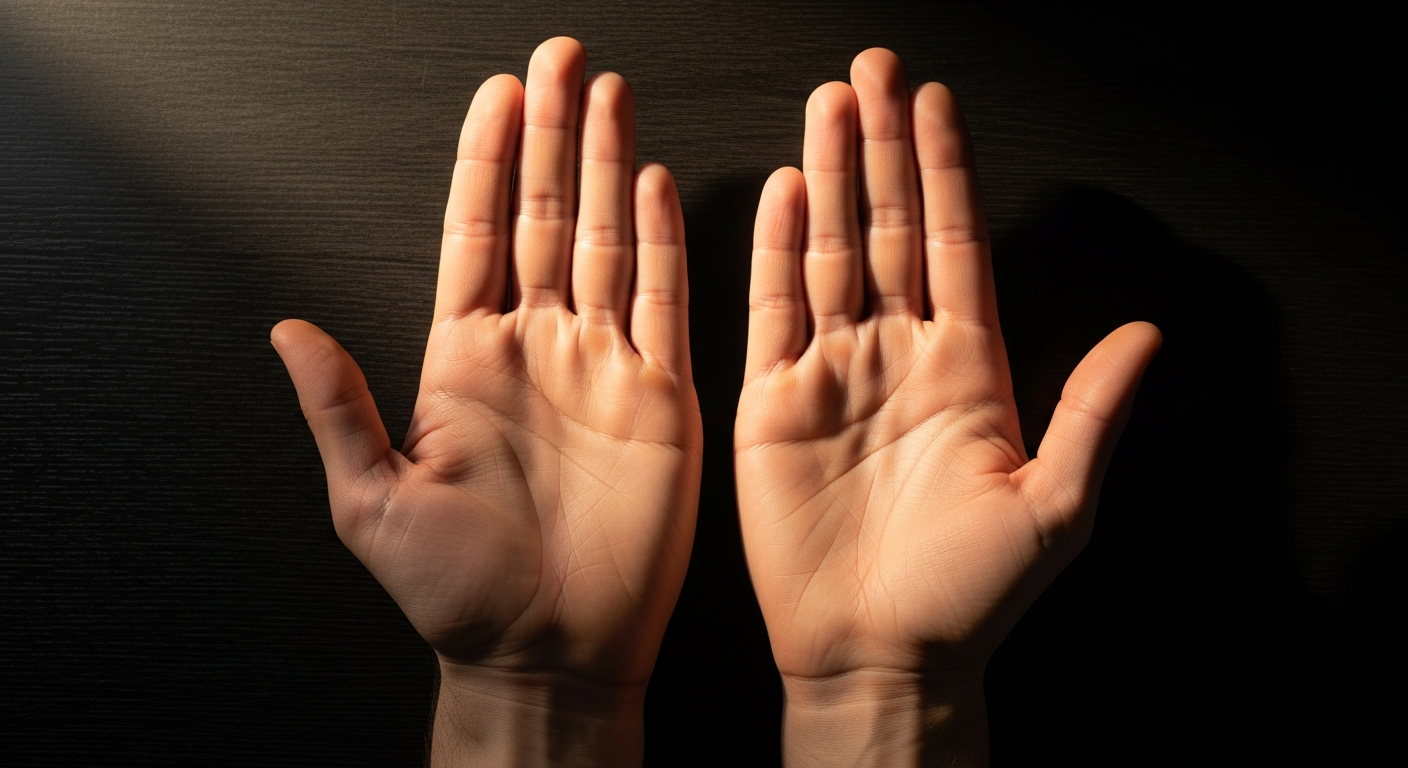
Now examine the palm itself. Cup your hand slightly to make the lines more visible. You are looking for four main lines — though not everyone has all four.
The Heart Line
The heart line is the uppermost horizontal line, running from the edge of the palm beneath the pinky finger toward the index finger or middle finger. It is also called the love line.
What it reveals: Your emotional nature, how you approach love and relationships, and your capacity for emotional connection.
How to read it:
- A long, curved heart line reaching toward the index finger suggests romantic expressiveness and emotional generosity
- A straight heart line indicates a more analytical approach to love — you think as much as you feel
- A short heart line ending under the middle finger suggests someone who values emotional independence
- Breaks in the heart line indicate emotional transitions — periods where your approach to love changed significantly. See our guide to broken heart lines
The Head Line
The head line crosses the middle of the palm, running roughly horizontally from between the thumb and index finger toward the opposite edge.
What it reveals: Your thinking style, intellectual approach, memory, and decision-making patterns.
How to read it:
- A long head line stretching across the palm suggests broad intellectual curiosity and a mind that considers many perspectives
- A straight head line indicates logical, analytical, practical thinking
- A curved head line that slopes downward suggests creative, intuitive, imaginative reasoning
- A short head line does not mean limited intelligence — it suggests focused, decisive thinking
- The depth of the line matters: a deep, clear line indicates strong concentration and mental clarity
The Life Line
The life line is the curved line that arcs around the base of the thumb, sweeping from between the thumb and index finger down toward the wrist.
What it reveals: Your vitality, energy level, major life changes, and overall approach to living.
What it does NOT reveal: Your lifespan. This is the most persistent myth in palmistry and it is completely false. A short life line does not mean a short life.
How to read it:
- A long, deep life line curving widely around the thumb suggests robust energy, enthusiasm, and a full life
- A life line close to the thumb suggests someone with lower physical energy or a more cautious, contained lifestyle
- Breaks indicate major life transitions — relocations, career changes, or transformative events. See our guide to broken life lines
- A faint life line does not indicate weakness — it may suggest someone whose energy is directed inward
The Fate Line
The fate line — also called the destiny line — runs vertically from the base of the palm toward the middle finger. The middle finger is the Saturn finger, which is why this is sometimes called the Saturn line or the line of destiny.
What it reveals: Your sense of direction, career path, and relationship with purpose.
How to read it:
- A clear, deep fate line running straight up the center of the palm suggests a strong sense of purpose from an early age
- A faint or absent fate line is not negative — it can indicate someone who creates their own path rather than following a predetermined one
- The starting point matters: a fate line beginning at the base of the palm suggests self-made success; one starting from the life line suggests family influence on career direction
- Breaks suggest career changes or shifts in life direction
Step 4: Look at the Minor Lines
Once you can identify the four major lines, begin noticing the smaller lines that add detail and nuance.
The marriage line — small horizontal lines above the heart line, on the edge of the palm beneath the little finger — reflects your approach to deep partnership.
The sun line — a vertical line running toward the ring finger — is also called the line of success. Its presence suggests creativity, recognition, and the potential for public achievement.
The health line — running from the lower palm toward the little finger (the Mercury finger) — reflects patterns of vitality and wellness. Its absence is traditionally a good sign.
The money line and money triangle — formations related to financial patterns and wealth-building ability.
For rare and unusual markings like mystic crosses, triangles, fish signs, and stars, see our guide to rare palm lines.
Step 5: Read the Mounts
The mounts of the palm are the fleshy raised areas beneath each finger and on the edges of the hand. Each mount is associated with a planet from astrology and planets in astrology traditions, and its development reveals which energies are strongest in your personality.
Mount of Jupiter (beneath the index finger): Leadership, ambition, confidence. A well-developed Jupiter mount suggests someone who naturally takes charge.
Mount of Saturn (beneath the middle finger): Discipline, responsibility, wisdom. A prominent Saturn mount indicates a thoughtful, serious nature.
Mount of Apollo/Sun (beneath the ring finger): Creativity, charisma, artistic talent. This mount reflects your relationship with self-expression and public life.
Mount of Mercury (beneath the little finger): Communication, intelligence, business acumen. Mercury governs how you express ideas and connect with others.
Mount of Venus (base of the thumb): Love, warmth, passion, vitality. The most prominent mount on most hands — its development reflects your emotional warmth and physical energy.
Mount of Moon (outer edge of the palm, opposite the thumb): Imagination, intuition, the unconscious mind. A developed Moon mount suggests rich inner life, meditation tendencies, and creative or psychic sensitivity.
Step 6: Put It All Together
Reading a palm is not about interpreting each line in isolation. It is about combining signals into a coherent picture — much like reading a face or understanding body language.
Start with the hand shape for the broad personality type. Then examine the major lines for the core story. Add the minor lines for detail. Consider the mounts for energy balance. Finally, compare the dominant and non-dominant hands for the narrative of growth and change.
A few principles for beginners:
No single line defines a person. A short heart line does not mean someone cannot love. A broken fate line does not predict future failure. Context always matters.
Lines change over time. Your palm lines are not fixed at birth. They can deepen, fade, extend, or develop new branches throughout your life. Even the skin texture and line depth evolve. This is one of the most fascinating aspects of palmistry — your hand reflects who you are becoming, not just who you were.
Palmistry is an art, not a science. It offers a framework for self-reflection, not medical diagnosis of disease or life prediction. It cannot determine whether a child will be healthy, whether you will become rich, or whether your future holds specific events. The best palm readers use the hand as a starting point for conversation and thought, not as a source of absolute truth.
Practice on your own hands first. Before reading anyone else's palm, spend time studying your own. Notice what the lines suggest and whether the interpretations feel relevant to your actual experience — whether you tend toward introversion or extraversion, whether you lead with logic or emotion. This builds both skill and equanimity — the emotional stability that makes a good reader.
Try Reading Your Own Palm
Ready to see what your palm lines reveal? Hold your dominant hand open in good light. Identify the heart, head, and life lines. Note their depth, curve, and length. Look for the fate line. Check the mounts.
Then, for a technology-assisted reading that identifies your lines automatically, try our free AI palm reading. Upload a photo and receive a personalized interpretation based on what your specific palm reveals — grounded in the traditions of Samudrika Shastra, Chinese palmistry, and Western chiromancy.
You can also explore our complete palm reading guide for deeper knowledge, or browse what all four palm lines mean.
Frequently Asked Questions
How do you interpret your palm lines?
Start with your dominant hand. Identify the four major lines: heart (top horizontal), head (middle horizontal), life (curved around thumb), and fate (vertical toward middle finger). Note each line's depth, length, curve, and any breaks. Then consider the hand shape and mounts for additional context.
Is palmistry 100% correct?
No. Palmistry is a traditional art form, not a science. It offers a framework for self-reflection based on thousands of years of observation, but it is not scientifically validated and should not be treated as absolute truth. The value is in the self-reflection it prompts, not in prediction.
Do I read left or right palm?
Most modern palmists read your dominant hand (usually right) as primary — it reflects your current personality and choices. Your non-dominant hand shows inherited traits. Traditional Indian and Chinese palmistry specifies left for females and right for males, but reading both hands provides the most complete picture.
What do the 5 lines on your palm mean?
Most palms show four major lines: the heart line (emotions and love), head line (thinking style), life line (vitality and life changes), and fate line (purpose and career). Some people also have a prominent sun line (creativity and recognition), making five visible lines.
How to read palm lines for money?
Financial indicators in palmistry include the money triangle (formed by the head line, fate line, and a connecting line), the sun line (associated with success and recognition), and markings on the mount of Mercury (business acumen). A strong fate line also suggests career-driven financial growth.
Palmistry is an ancient art practiced across cultures for thousands of years. All readings are for educational and entertainment purposes. They are not scientifically validated and should not replace professional advice of any kind.
The Art of Palmistry
Go deeper with our 20-chapter visual guide. Learn hand shapes, lines, mounts, and how to read a palm step by step.
Read the Book →See what your palm reveals
Upload a photo and get an instant AI-powered reading based on the traditions discussed in this article.
Read My Palm — It's Free