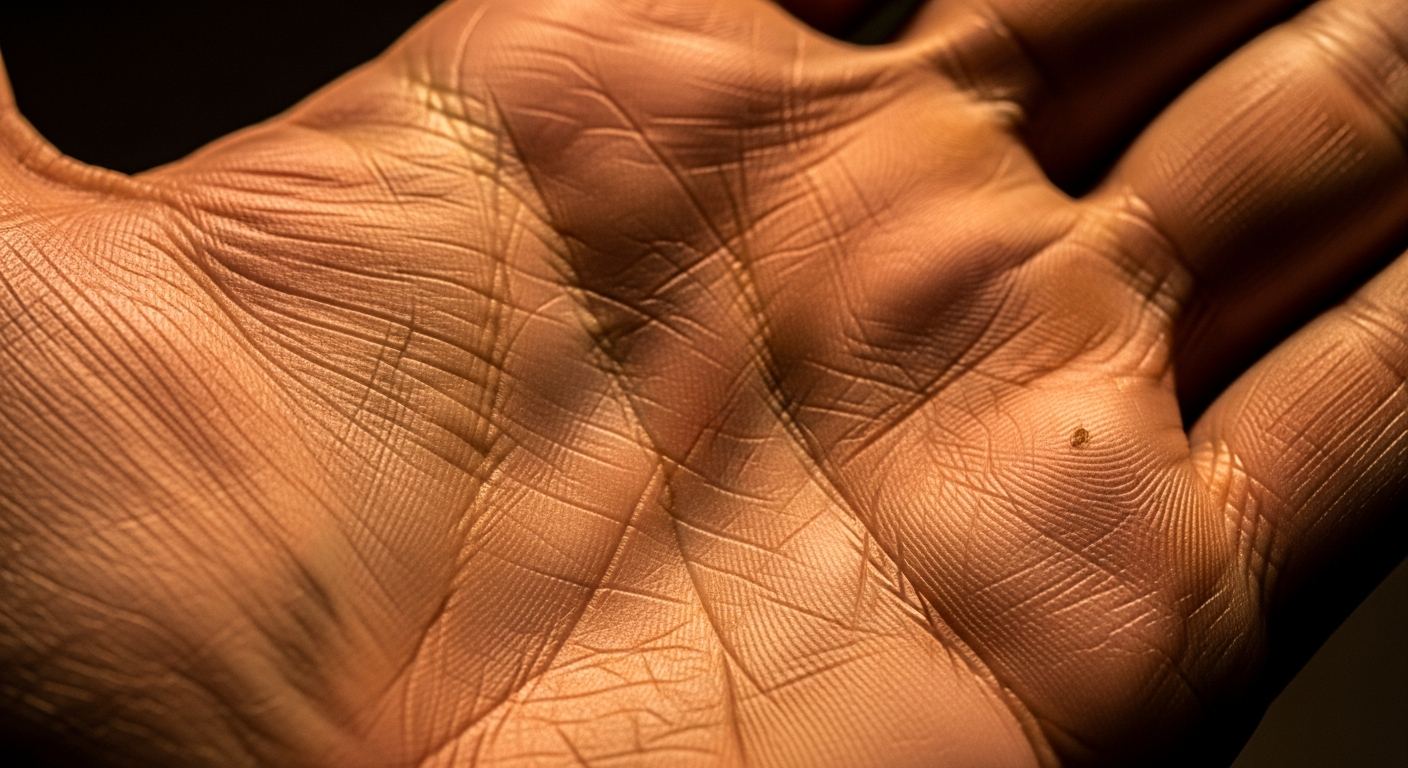
Rare Palm Lines and Their Meanings: Signs, Symbols & Lucky Markings
Beyond the four major palm lines lies a world of rare markings that most people never notice — and that many palmists consider the most fascinating features of a hand. These are the signs that appear on only a small percentage of palms: mystic crosses, triangles, fish signs, lotus markings, and unusual line formations that have carried special meaning across palmistry traditions for thousands of years. They do not predict the future — but in the traditions that study them, they reveal something almost magical about a person's character, talents, and potential.
Not every palm has rare lines. Their absence means nothing negative — the four major lines (heart, head, life, and fate) provide a complete reading on their own. But when rare signs do appear, they add layers of meaning that palmists across cultures — from Indian astrology and Samudrika Shastra to Western chiromancy and Chinese palmistry — have studied with particular attention.
The Mystic Cross
The mystic cross is one of the most sought-after rare signs in palmistry. It appears as a small cross or X formation between the heart line and the head line, roughly in the center of the palm.
In Indian palmistry, the mystic cross is associated with strong intuition, spiritual awareness, and an interest in mysticism, metaphysics, or the occult. People with this marking are traditionally believed to have a natural gift for understanding things beyond the surface — a sensitivity to the unseen dimensions of life.
In Western chiromancy, the mystic cross is read as a sign of someone drawn to philosophy, religion, or spiritual practice. It does not necessarily mean you are psychic — it suggests a mind that is naturally oriented toward deeper questions about meaning and purpose.
Not every cross-shaped marking on the palm qualifies as a mystic cross. It must sit independently between the heart and head lines, not formed by the intersection of other minor lines. A true mystic cross is distinct, clearly formed, and relatively rare.
The Triangle
Triangles on the palm are considered auspicious signs in virtually every palmistry tradition. The meaning depends on where the triangle appears.
The Great Triangle — formed by the intersection of the life line, head line, and a connecting line — is one of the most significant formations in palm reading. A large, well-defined great triangle suggests intelligence, good fortune, and a balanced temperament. The wider the triangle, the more generous and broad-minded the person is believed to be.
A triangle on the mount of Jupiter (beneath the index finger) suggests leadership ability, wisdom in decision-making, and success in fields that require authority or public trust. In Hindu astrology, Jupiter is associated with the god of wisdom and expansion, and a triangle here amplifies those qualities.
A triangle on the mount of Saturn (beneath the middle finger) can indicate an aptitude for research, deep study, or occult knowledge. Saturn governs discipline and structure, and a triangle here suggests someone who applies reason and persistence to uncover hidden truths.
A triangle on the mount of Venus (the fleshy area at the base of the thumb) relates to emotional control and wisdom in love. Rather than being overwhelmed by passion, a person with this marking tends to navigate relationships with both heart and mind.
A triangle on the mount of Mercury (beneath the little finger) suggests skill in communication, business, or diplomacy. Mercury governs language, commerce, and intellect, and this triangle amplifies those talents.
A triangle on the mount of Moon (the outer edge of the palm, opposite the thumb) is traditionally read as a sign of creative intuition — someone whose imagination produces meaningful work rather than idle fantasy.
The Fish Sign
The fish sign — called matsya in Indian palmistry — is one of the rarest and most auspicious markings in the entire tradition of palm reading. It appears as a small fish-shaped formation, usually found near the base of the palm or on one of the mounts.
In Vedic astrology and Hindu tradition, the fish is a sacred symbol. The matsya avatar — the fish incarnation of Vishnu — represents protection, wisdom, and divine guidance. A fish sign on the palm is traditionally associated with wealth, spiritual depth, and a life blessed by good fortune. In the traditions connected to the goddess Lakshmi, the fish sign is considered a mark of prosperity.
In Western palmistry, the fish sign is less commonly discussed but is generally read as a positive indicator of material and spiritual abundance.
The fish sign is extremely rare. Most palmists will see only a handful of genuine fish signs across hundreds of palm readings. Its rarity is part of what gives it such significance in the traditions that recognize it.
The Lotus Sign
The lotus sign — also called the temple sign or conch marking — is another rare formation found primarily in Indian palmistry traditions. It appears as a pattern resembling the sacred lotus flower, usually on one of the mounts.
In Hindu and Buddhist tradition, the sacred lotus represents spiritual awakening, beauty emerging from difficulty, and divine grace. The goddess Saraswati, associated with knowledge and art, and the goddess Lakshmi, associated with wealth and beauty, are both depicted with the lotus. A lotus marking on the palm is read as a sign of spiritual development, artistic talent, or a life touched by something sacred.
Lucky Signs and Auspicious Markings
Several other rare markings are considered lucky signs in palmistry.
The star — a small asterisk-shaped formation — carries different meanings depending on its location. A star on the mount of Jupiter suggests sudden success or recognition. A star on the mount of Sun (Apollo) indicates fame or creative achievement. However, a star on the mount of Saturn can suggest sudden difficulty — stars amplify whatever energy the mount already carries.
The trident — a three-pronged marking resembling a fork — is considered extremely auspicious, particularly when found at the end of a major line. A trident at the end of the fate line suggests success in career from multiple directions. A trident on the mount of Jupiter is one of the most fortunate signs in Indian palmistry, associated with power, wealth, and wisdom combined.
Vertical lines on the mounts generally strengthen whatever quality that mount represents. Each mount is associated with a planet — Jupiter, Saturn, Sun, Mercury, Moon, Venus — and its corresponding qualities from astrology and horoscope traditions. Clear vertical lines on Jupiter enhance leadership. Vertical lines on Mercury strengthen communication. Vertical lines on the mount of Sun enhance creativity and recognition.
The ring of Solomon — a curved line encircling the base of the index finger — is associated with wisdom, teaching ability, and deep understanding of human nature. In palmistry, Solomon's ring suggests someone who naturally counsels, guides, and leads through insight rather than force.
The Money Triangle
The money triangle is formed when the head line, the fate line, and a connecting line create a triangular shape in the center of the palm. It is not a single marking but a formation created by the intersection of existing lines.
A clear, well-formed money triangle suggests financial acumen — an ability to earn, manage, and grow wealth. The more defined and enclosed the triangle (without gaps or breaks in the lines), the stronger the indication of financial good fortune.
If the triangle has gaps — places where the lines do not fully connect — traditional palmistry reads this as money that comes but does not stay. The gap suggests a tendency toward financial leakage, whether through poor management, generosity, or circumstances beyond your control.
The money line itself provides additional context about financial patterns in your palm.
The Girdle of Venus
The girdle of Venus is a curved line — or series of broken lines — that arcs above the heart line, running from between the index and middle finger to between the ring and little finger.
This marking is associated with heightened emotional sensitivity, aesthetic appreciation, and deep feeling. People with the girdle of Venus tend to be moved by beauty, music, and art. They experience emotions intensely and often have strong creative or artistic tendencies.
The girdle of Venus is not always a single clean line — it frequently appears as a broken or fragmented arc. In palmistry, a complete girdle suggests controlled sensitivity, while a broken girdle can indicate emotional volatility or a tendency to become overwhelmed by intense feelings.
The Simian Line
The simian line — where the heart line and head line merge into a single crease running across the palm — is one of the rarest formations in palmistry, appearing in roughly four percent of hands. It is also called the single transverse palmar crease.
People with a simian line tend to experience thought and emotion as a single force rather than separate channels. This creates intensity — in focus, in passion, in determination. The simian line is found on the dominant hand of many highly driven individuals.
For a complete exploration of this rare marking, see our dedicated guide to the simian line.
The Letter M
When the heart line, head line, life line, and fate line intersect in a way that creates a clear letter M on the palm, it is considered a sign of good fortune, strong intuition, and leadership potential. The letter M is rare enough to be noteworthy but common enough that many people discover it when they look carefully.
How to Identify Rare Signs on Your Palm
Rare markings are often small and easy to miss. To look for them:
Hold your palm in strong, even light. Look beyond the four major lines — examine the spaces between them, the mounts beneath each finger, and the area near the wrist. Use a magnifying glass if needed. Many rare signs are only a few millimeters across.
Keep in mind that not every crossing, triangle, or mark is a significant palmistry sign. Context matters — a true mystic cross, for instance, must be independent of other line formations to carry its traditional meaning.
For a technology-assisted reading that identifies your major palm lines automatically, try our free AI palm reading. While rare markings require detailed examination that current technology is still learning to detect, your four major lines provide a rich and complete foundation for a personalized reading.
You can also explore our complete guide to palm reading or learn about the mounts of the palm where many rare signs appear.
Frequently Asked Questions
What are the rarest lines on your palm?
The rarest palm markings include the mystic cross (between heart and head lines), the fish sign (matsya), the lotus sign, the simian line (found in roughly 4% of hands), and the ring of Solomon. True instances of these markings are uncommon and carry special significance across palmistry traditions.
What is the rarest line in the world?
The fish sign (matsya) is considered one of the rarest markings in palmistry. It appears as a small fish-shaped formation, usually near the base of the palm. In Indian palmistry, it is associated with wealth, spiritual depth, and divine blessing.
Which hand lines are lucky?
Lucky markings in palmistry include the trident (especially on the mount of Jupiter), the star on the mount of Sun, a well-formed money triangle, the mystic cross, and clear vertical lines on the mounts. The letter M formation — where the four major lines intersect to create an M shape — is also considered fortunate.
Is rare hand lines meaning spiritual?
Many rare palm markings carry spiritual significance, particularly in Indian palmistry traditions. The mystic cross is associated with intuition and spiritual awareness. The fish sign connects to divine protection. The lotus sign relates to spiritual awakening. However, their spiritual meaning is a matter of traditional belief, not scientific fact.
Do the lines on your hands mean anything?
Yes, within the tradition of palmistry. Palm reading is one of humanity's oldest systems for self-reflection, practiced across India, China, Greece, and Europe for thousands of years. While not scientifically validated, palm lines offer a framework for exploring personality, emotional patterns, and life tendencies.
Palmistry is an ancient art with deep roots in Indian, Chinese, and European traditions. Rare palm markings carry significance within these traditions but are not scientifically validated. All readings are for educational and entertainment purposes.
The Art of Palmistry
Go deeper with our 20-chapter visual guide. Learn hand shapes, lines, mounts, and how to read a palm step by step.
Read the Book →See what your palm reveals
Upload a photo and get an instant AI-powered reading based on the traditions discussed in this article.
Read My Palm — It's Free